
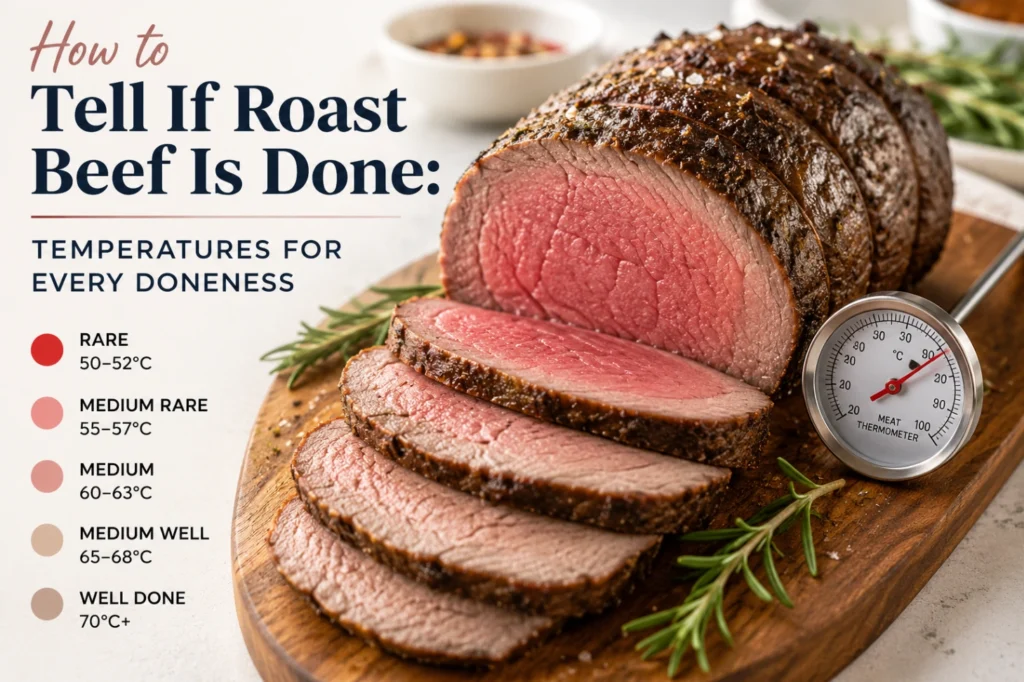
How to Tell When Roast Beef Is Done
Knowing when roast beef is perfectly cooked can be tricky. You want it tender and juicy in the middle, but you also need to know that it has reached a safe temperature for serving.
The outside of a roast can look beautifully browned while the centre is still cooking, and cutting into the meat to check can let valuable juices escape. Cooking time can also vary depending on the size and shape of the roast, the oven temperature and whether the beef started from cold.
So, how can you tell when roast beef is actually done?
The most reliable way is to check the internal temperature of the thickest part of the roast rather than relying on colour, cooking time or appearance alone. Once you know the temperature you’re aiming for, it becomes much easier to cook roast beef to the doneness you prefer without accidentally overcooking it.
In this guide, we’ll look at the temperatures for different levels of doneness, where to check your roast, why the temperature continues to rise while the beef rests, and what to do if your roast is undercooked or more done than you intended.
How Do You Know When Roast Beef Is Done?
The most reliable way to tell when roast beef is done is to check its internal temperature with a meat thermometer.
Unlike cooking time or appearance, the temperature inside the roast gives you a much better indication of how far it has cooked. The outside of the beef can brown quickly while the centre is still relatively cool, and two roasts of the same weight can take different amounts of time to cook.
For the most accurate reading, check the thickest part of the roast, making sure the thermometer isn’t touching bone or sitting in a large pocket of fat.
The temperature you are aiming for will depend on how you like your roast beef cooked, from rare through to well-done. It’s also important to remember that the temperature can continue to rise slightly after the beef comes out of the oven as it rests.
If you’re unsure how to use a meat thermometer correctly, our How to Cook Meat to the Right Temperature guide covers the basics in more detail. This allows this article to focus specifically on getting your roast beef to the doneness you want.
Roast Beef Internal Temperatures
The internal temperature you choose will depend on how you like your roast beef cooked. As a general guide, the lower the final temperature, the rarer the beef will be.
Because roast beef continues cooking slightly while it rests, you don’t necessarily need to leave it in the oven until it reaches your final target temperature. Taking it out a little earlier allows for this carryover cooking while the roast rests.
| Doneness | Approximate final internal temperature |
|---|---|
| Rare | 50–52°C |
| Medium-rare | 55–57°C |
| Medium | 60–63°C |
| Medium-well | 65–68°C |
| Well-done | 70°C+ |
These temperatures are useful for understanding doneness and cooking preference, but they should not be confused with food-safety guidance. For food safety, follow the recommendations applicable to the type of beef you are cooking and your local food-safety authority.
For a more detailed explanation of safe meat temperatures and how to use a thermometer, see our How to Cook Meat to the Right Temperature guide.
A quick note about temperature ranges
Don’t worry if your thermometer doesn’t show exactly the same number every time. A roast will continue to cook as it rests, and the final temperature can vary depending on the size of the roast and how long it has been resting.
For the most consistent results, choose the level of doneness you want before you start cooking and use the temperature as your guide rather than relying on a particular cooking time.
Where to Check the Temperature in Roast Beef
Getting the thermometer into the right part of the roast is just as important as knowing the temperature you’re aiming for.
The centre of the thickest part of the roast is usually the slowest area to cook, so this is where you want to take your reading.
Check the thickest part
Insert the thermometer into the thickest part of the beef, aiming towards the centre. This gives you a better indication of the temperature of the meat that has taken the longest to cook.
Avoid touching bone
If your roast contains a bone, make sure the thermometer isn’t touching it. Bone can affect the reading and may give you a temperature that doesn’t accurately represent the surrounding meat.
Avoid large pockets of fat
Try to position the thermometer in the meat rather than in a thick section of fat. Fat can heat differently from the surrounding muscle and may not give you the most useful reading.
For smaller or flatter roasts
If your roast is relatively thin, insert the thermometer from the side rather than straight down from the top. This makes it easier to position the probe in the centre of the meat rather than accidentally passing through the middle.
Take more than one reading if needed
For a large roast, you can check the temperature in a couple of different spots. If one area is noticeably cooler than another, use the lowest reading as your guide and allow the roast to continue cooking until the appropriate temperature is reached.
Once you’ve taken your reading, remove the roast from the oven when appropriate for your chosen level of doneness and allow it to rest before carving. The temperature can continue to rise slightly during this time.
Why Roast Beef Can Look Pink Even When It Is Done
One of the most confusing things about cooking roast beef is that pink meat doesn’t necessarily mean the beef is undercooked.
The colour of roast beef can vary depending on the cut of meat, cooking method, temperature and other factors. Beef can remain pink in the centre even after it has reached the temperature you were aiming for.
This is why cutting into the roast and judging it purely by colour isn’t the most reliable way to tell whether it is done.
Instead, use the internal temperature as your main guide. A thermometer gives you a much better indication of how the centre of the roast has cooked than appearance alone.
What if my roast is still pink?
If your roast has reached the temperature appropriate for your chosen level of doneness, a pink centre can be completely expected—particularly with rare or medium-rare beef.
On the other hand, if you’re concerned that the roast hasn’t reached a safe temperature, don’t rely on the colour to reassure you. Check the temperature in the thickest part and continue cooking if necessary.
Don’t confuse pink with raw
Rare roast beef can have a noticeably red or pink centre while still being intentionally cooked to that level of doneness. The texture will also be different from genuinely raw beef.
The key takeaway is simple: colour can help you understand how your roast looks, but temperature is a much more useful tool for determining how it has cooked.
Why the Temperature Rises While Roast Beef Rests
If you’ve ever taken roast beef out of the oven and noticed that the temperature keeps climbing, don’t worry – this is normal.
It is called carryover cooking. The outside of the roast is hotter than the centre when it comes out of the oven, so heat continues moving towards the middle while the beef rests. As a result, the internal temperature can rise by several degrees after the roast leaves the oven.
This is one reason you don’t always want to wait until the thermometer reaches your final target temperature before removing the roast from the oven. If you do, the beef may continue cooking beyond your preferred level of doneness.
Why resting matters
Resting isn’t just about temperature. Giving the roast time to rest also allows the juices to redistribute through the meat, helping it stay more moist when you carve it.
Place the cooked roast on a board or serving plate and loosely cover it with foil. Avoid wrapping it tightly, as this can trap too much heat and soften the browned exterior.
The exact amount of temperature rise will vary depending on the size and shape of the roast, how hot the oven was and how long the beef continues to cook.
For this reason, think of the temperature at the end of cooking as a guide rather than a single magic number. Your roast can continue changing after it comes out of the oven.
Can You Tell If Roast Beef Is Done Without a Thermometer?
You can make an educated guess without a thermometer, but it is much harder to accurately judge when roast beef is done.
Some traditional methods involve checking the colour of the centre, the firmness of the meat or calculating cooking time based on its weight. While these can give you an idea, they aren’t as reliable as checking the internal temperature.
Using cooking time
Recipes often give an estimated cooking time based on the weight of the roast. This can be useful for planning, but it shouldn’t be treated as a guarantee.
The actual cooking time can vary depending on:
- The size and shape of the roast
- The cut of beef
- Whether the beef started cold or had been brought closer to room temperature
- Your oven and its temperature accuracy
- Whether the roast is covered or uncovered
- How you like your beef cooked
Checking the colour
Cutting into the roast to look at the centre can tell you something about its appearance, but colour isn’t a dependable way to determine whether the meat has reached a particular temperature.
It can also cause some of the juices to escape, particularly if you keep cutting into the roast while it is cooking.
Checking how firm it feels
Experienced cooks sometimes use the firmness of meat as an indication of doneness. However, this takes practice and can be difficult to judge consistently, especially with different cuts of beef.
So, what is the easiest option?
If you cook roast beef regularly, a digital meat thermometer is one of the simplest kitchen tools you can use to take the guesswork out of cooking.
You don’t need to keep cutting into the roast or rely entirely on cooking times. Instead, you can check the internal temperature and use that information alongside the recipe and your preferred level of doneness.
In short: cooking time can be a guide, but temperature gives you a much clearer picture of what is happening inside the roast.
Signs Your Roast Beef May Be Overcooked
Roast beef that has been cooked beyond your preferred level of doneness can become firmer, drier and less juicy. While some cuts handle longer cooking better than others, lean roasting cuts can lose moisture relatively quickly when overcooked.
Here are some signs that your roast may have gone further than you intended:
The centre is much firmer than expected
As beef cooks, the texture becomes progressively firmer. If you were aiming for medium-rare or medium beef but the centre feels quite firm, it may have been cooked past your preferred doneness.
The meat looks uniformly brown
A roast that is cooked well-done will generally have little to no pinkness through the centre. However, remember that colour alone isn’t a reliable way to determine doneness.
The slices are dry
If the beef feels dry or requires a lot of chewing, it may have been cooked for too long or at too high a temperature.
The juices seem limited
A roast that has been overcooked can release more moisture during cooking, leaving the finished meat less juicy than you wanted.
The internal temperature went well beyond your target
The best way to avoid overcooking is to monitor the internal temperature as the roast approaches your preferred level of doneness. Remember that the temperature can continue to rise while the beef rests.
If your roast is slightly more cooked than you wanted, don’t throw it away. Thinly sliced beef can still work well in sandwiches, wraps, salads or with plenty of gravy or sauce. The key is to slice it thinly across the grain and add moisture where you can.
What to Do If Your Roast Beef Is Undercooked
If you cut into your roast beef and discover that the centre is less cooked than you intended, there is usually no need to panic. You can put the roast back into the oven and continue cooking it until it reaches the temperature you’re aiming for.
Put the roast back in the oven
Return the beef to the oven and continue cooking. If the outside is already well browned, you can loosely cover it with foil to help prevent the exterior from becoming too dark while the centre catches up.
Check the internal temperature again after a short period of cooking rather than relying on the original cooking time.
Use the thermometer to guide you
Insert the thermometer into the thickest part of the roast and check the temperature again. If the centre hasn’t reached the temperature you want, continue cooking and check again.
This is much more reliable than simply adding another set amount of cooking time because every roast cooks differently.
If you’ve already carved the roast
If you’ve sliced the beef and realised the centre is too rare for your preference, you can place the slices back into the oven or a hot pan briefly to cook them further.
Try not to overcook the entire roast just because one person prefers their beef more well-done. Individual slices can be cooked further to suit different preferences.
Don’t rely on colour alone
A pink or red centre doesn’t automatically mean that beef is unsafe, just as brown meat doesn’t guarantee that it has reached a particular temperature.
If you’re concerned about whether the beef has been cooked sufficiently, check its internal temperature rather than judging it by colour alone.
If the roast has been left sitting at room temperature for an extended period, however, cooking it again isn’t necessarily enough to make it safe. Food-safety guidance should be followed for meat that has been improperly stored or held at unsafe temperatures.
How Long Does Roast Beef Take to Cook?
There isn’t one cooking time that will work for every roast beef. The time required depends on the weight and shape of the roast, the cut of beef, the oven temperature and your preferred level of doneness.
Cooking time can be useful when planning your meal, but it should be treated as an estimate rather than a way to determine whether the roast is done.
Why cooking times vary
Two roasts that weigh the same can take different amounts of time to cook. A long, narrow roast may cook differently from a shorter, thicker one because heat needs to travel a different distance to reach the centre.
Other factors that can affect cooking time include:
- The starting temperature of the beef
- The size and shape of the roast
- The particular cut of beef
- Your oven’s actual temperature
- Whether the roast is covered or uncovered
- The temperature you are aiming for
Use time as a guide, not a guarantee
If your recipe gives you a cooking time, use it to estimate when you should start checking the roast. As you get closer to the expected finishing time, check the internal temperature in the thickest part of the beef.
This gives you much more control than simply removing the roast when the timer goes off.
A good approach is to use cooking time to plan and temperature to decide when to check for doneness.
If you’re cooking for a particular meal time, remember to allow extra time for the roast to rest before carving. It’s better to have the beef finished a little early than to be rushing to get it onto the table.
Common Roast Beef Cooking Mistakes
Even a good-quality roast can end up dry, tough or more cooked than you wanted if a few simple steps are missed. The good news is that most roast beef mistakes are easy to avoid once you know what to look for.
Relying only on cooking time
Cooking times are useful estimates, but they don’t account for every roast or every oven. Use the recipe time as a starting point, then check the internal temperature as the roast gets closer to being done.
Judging doneness by colour alone
A pink centre doesn’t necessarily mean the beef is undercooked, and a brown centre doesn’t automatically tell you that it has reached a particular temperature.
Use internal temperature as a more reliable guide.
Checking the wrong part of the roast
Taking a temperature near the surface can give you a reading that is higher than the centre. Always aim for the thickest part of the roast and avoid touching bone or sitting the probe in a large pocket of fat.
Waiting until the final temperature before removing the roast
Remember that roast beef can continue cooking as it rests. If you wait until the centre reaches your final target temperature in the oven, the beef may end up more cooked than you intended.
Skipping the resting time
Carving immediately can make it harder for the roast to retain its juices. Allow the beef to rest before slicing so the heat and moisture can settle through the roast.
Cutting into the roast repeatedly
It can be tempting to keep checking the centre, especially if you don’t have a thermometer. However, repeatedly cutting into the meat releases juices and still doesn’t give you a precise indication of temperature.
A thermometer lets you check the roast with minimal disruption.
Slicing the beef incorrectly
Even a perfectly cooked roast can seem tough if it is sliced in the wrong direction. Look for the direction of the muscle fibres and slice across the grain rather than along it. This shortens the muscle fibres and can make each slice easier to chew.
Making every roast the same way
Different cuts of beef are suited to different cooking methods. A lean roasting cut may be best cooked to a particular level of doneness, while tougher cuts often benefit from longer, slower cooking.
Before you start, check what type of beef roast you’re working with and choose a cooking method that suits the cut.
Frequently Asked Questions About Roast Beef Doneness
How do I know when roast beef is done?
The most reliable way is to check the internal temperature in the thickest part of the roast with a meat thermometer. Cooking time and colour can provide clues, but they are less reliable on their own.
What temperature should roast beef be for medium-rare?
For medium-rare beef, a common target is around 55–57°C as a final internal temperature. Because the temperature can continue to rise while the roast rests, you may remove it from the oven slightly before it reaches the final temperature you’re aiming for.
Can roast beef be pink and still be done?
Yes. Roast beef can remain pink or red in the centre depending on the level of doneness. Colour alone isn’t a reliable way to determine whether the beef has reached the temperature you want.
Why did my roast beef get more cooked while resting?
This is called carryover cooking. Heat from the hotter outer parts of the roast continues moving towards the cooler centre after the beef comes out of the oven, causing the internal temperature to rise.
How long should roast beef rest before carving?
The resting time depends on the size of the roast. A larger roast generally benefits from a longer rest than a small one. Allowing the beef to rest gives the temperature time to settle and helps the roast retain more of its juices when sliced.
Can I tell if roast beef is done by cooking time?
Cooking time can give you an estimate, but it shouldn’t be your only method for judging doneness. Roast size, shape, cut, starting temperature and oven performance can all affect how quickly it cooks.
What if my roast beef is undercooked?
If the centre hasn’t reached the temperature you’re aiming for, return the roast to the oven and continue cooking. Check the temperature again after a short period rather than simply adding a large amount of cooking time.
Why is my roast beef tough even though I didn’t overcook it?
Toughness isn’t always caused by overcooking. The cut of beef, how it was prepared, the cooking method and the direction in which it was sliced can all affect tenderness. Slicing across the grain can make a noticeable difference.
Should I use a meat thermometer for roast beef?
Yes. A meat thermometer is one of the easiest ways to reduce guesswork when cooking roast beef. It allows you to monitor what’s happening inside the roast without repeatedly cutting into it.
For a detailed guide to using a thermometer and understanding meat temperatures, see our How to Cook Meat to the Right Temperature guide.
The Bottom Line: How to Tell When Roast Beef Is Done
The easiest way to take the guesswork out of roast beef is to use the internal temperature as your main guide.
Cooking times can help you plan your meal, while colour and texture can give you clues about how the beef has cooked. But checking the temperature in the thickest part of the roast gives you a much clearer indication of what is happening inside.
Remember to:
- Choose your preferred level of doneness before cooking.
- Use cooking time as a guide rather than a guarantee.
- Check the temperature in the thickest part of the roast.
- Avoid touching bone or large pockets of fat with the thermometer.
- Allow for some carryover cooking while the beef rests.
- Give the roast time to rest before carving.
- Slice across the grain for a more tender bite.
Once you get into the habit of checking the temperature rather than relying entirely on the clock, cooking roast beef becomes much less stressful. You can cook it to the level of doneness your family enjoys while avoiding the disappointment of an overcooked or undercooked centre.
More Helpful Meat Cooking Guides
If you’re learning how to cook meat with more confidence, these guides can help you take the guesswork out of temperature, doneness and safe cooking.
How to Cook Meat to the Right Temperature
Our overarching guide explains how to use internal temperature as a reliable way to check meat, with a broader look at cooking temperatures across different types of meat.
Read next: How to Cook Meat to the Right Temperature
How to Tell When Steak Is Done
Cooking steak is slightly different from cooking a whole roast. This guide looks at steak doneness and how to check whether your steak is rare, medium-rare, medium or well-done.
Read next: How to Tell When Steak Is Done
How to Cook Pork Safely Without Drying It Out
Pork can be tricky to get right because you want it safely cooked without ending up with dry, tough meat. This guide explains how temperature, cooking method and resting can help.
Read next: How to Cook Pork Safely Without Drying It Out
More Cooking Guides
Explore more Cooking Guides for practical tips, troubleshooting advice and easy ways to become a more confident home cook.